

At Iberohemp, we take the quality, storage and purity of our products very seriously. That is why, in this guide, we explain why mould can appear on CBD flowers, how to identify possible signs of contamination and which factors can encourage its development.
We also cover good storage practices, the importance of professional testing and the main criteria to consider when choosing CBD flowers. If you would like to learn more about our products and how we work, you can visit Iberohemp.
By the end, you will have a clear guide to identifying potential storage problems and protecting product quality.
Why mould forms on CBD flowers
Mould on CBD flowers can develop when growing, drying, handling or storage conditions encourage the growth of certain fungi.
High humidity, inadequate drying, insufficient ventilation or poor storage conditions can facilitate the proliferation of microorganisms. Fungi that can affect cannabis include genera such as Aspergillus and species such as Botrytis cinerea.
Likewise, condensation inside the packaging or unsuitable environmental conditions during storage can increase the risk of deterioration.
Understanding these factors helps to keep CBD flowers under appropriate storage conditions and identify potential abnormalities before purchasing or storing the product.
How to recognise mouldy CBD flowers before buying
Identifying certain visible signs can help detect flowers showing signs consistent with mould or deterioration.
When examining each flower, it is advisable to pay attention to visual, olfactory and tactile signs. None of these criteria replaces laboratory testing, but they can help identify obvious abnormalities in the product.
Below are three aspects worth checking.
Changes in colour and unusual marks
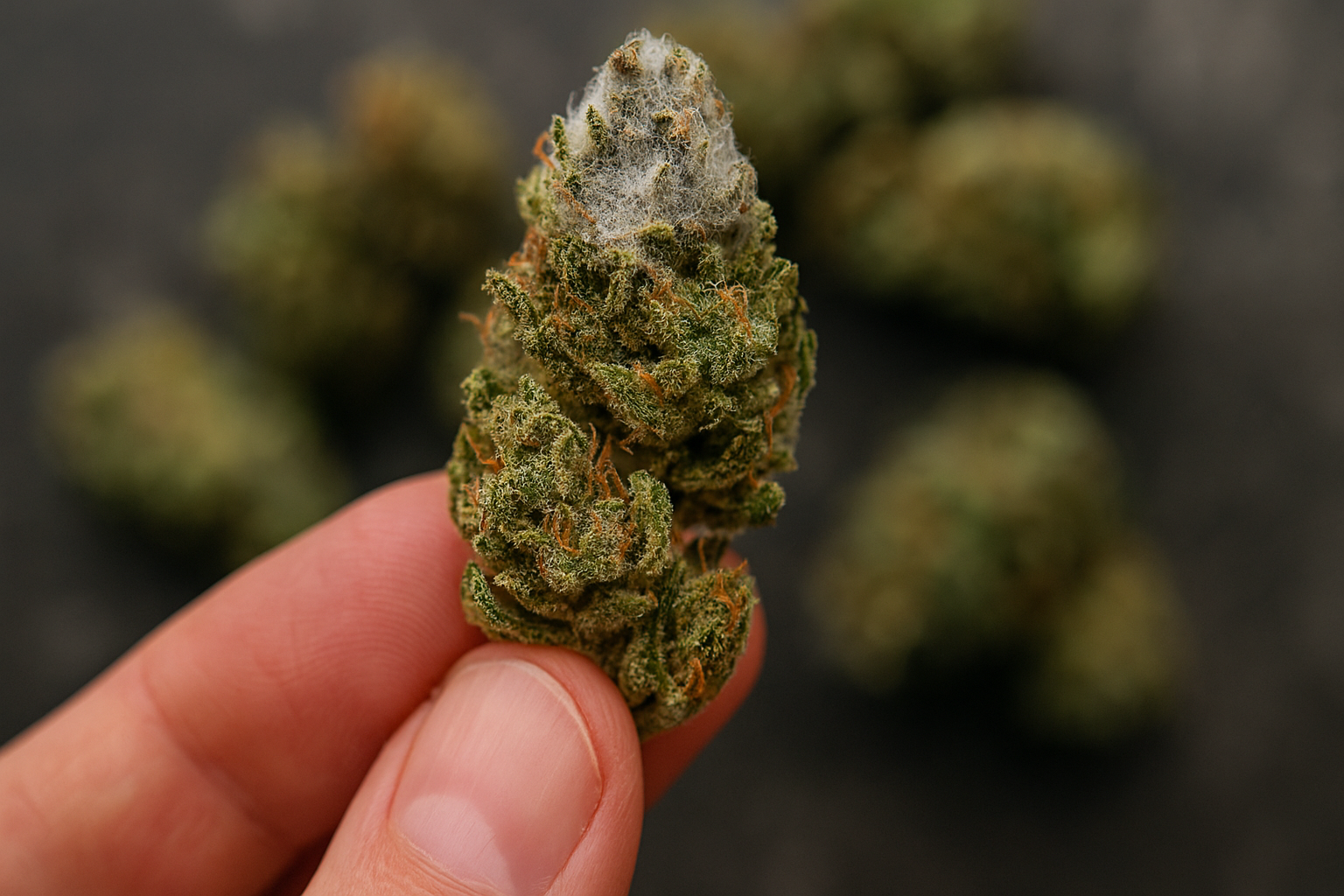
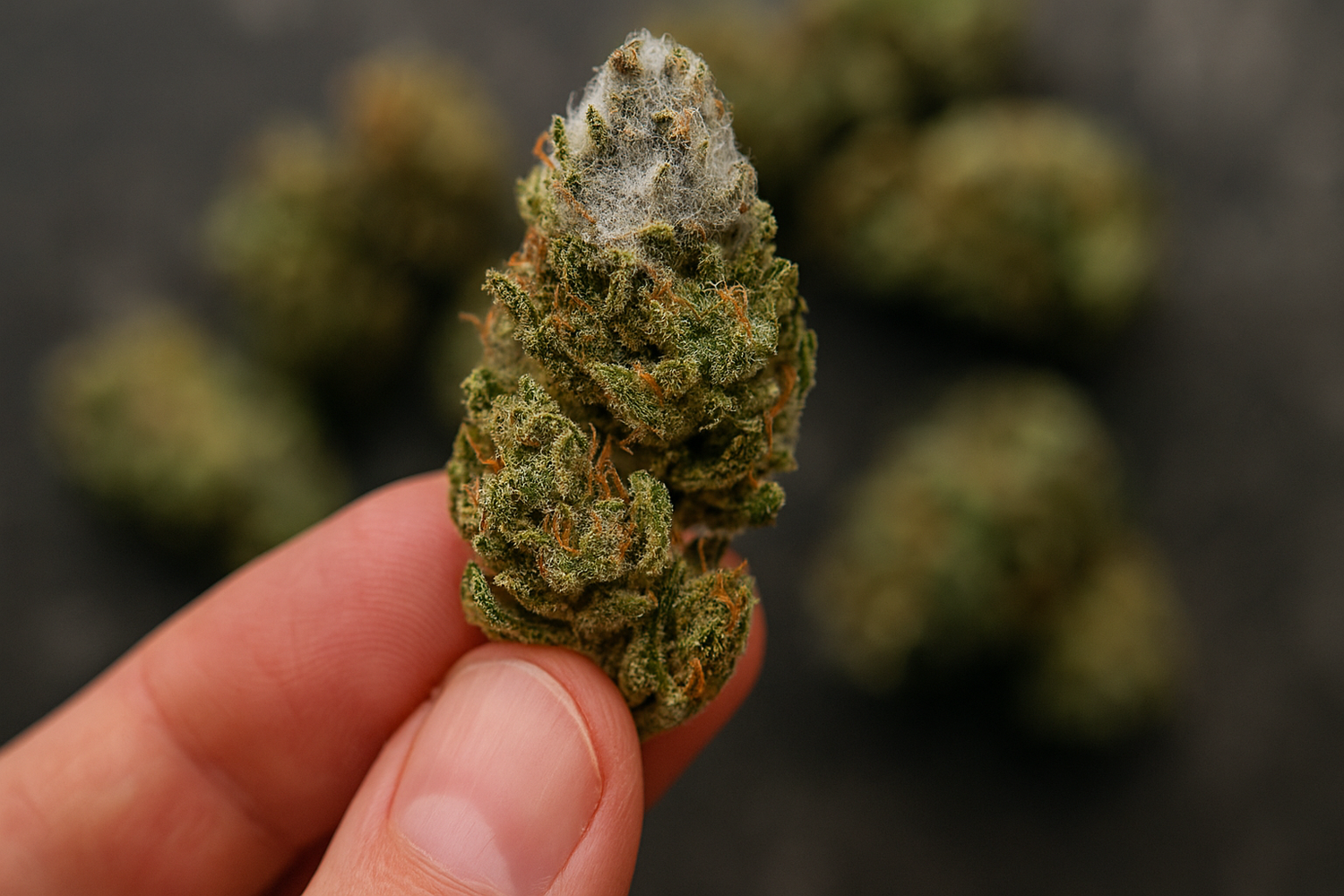
Flowers affected by certain fungi may develop whitish, greyish or greenish areas, or marks that do not match the flower’s usual appearance.
These changes may appear as powder, filaments or patches on different parts of the flower.
It is important not to confuse these signs with trichomes, natural structures on the plant that can give the flower a whitish or crystalline appearance.
If clearly unusual areas, filaments or marks appear alongside other signs of deterioration, the sensible approach is to avoid using or unnecessarily handling the product and contact the supplier.
Damp or musty smell
CBD flowers can have different aromatic profiles depending on their variety and composition. However, a smell clearly associated with damp, mould, a musty cellar or deteriorating plant material may indicate poor storage conditions.
Smell alone cannot confirm microbiological contamination, but when combined with visible changes to the flower, it can be a warning sign.
If you notice an unusual smell when opening a product that does not match its normal characteristics, it is advisable to check its condition before handling it further.
Changes in texture and feel
Texture can also provide information about the product’s condition.
A flower that is excessively damp, softened or has clearly deteriorated areas may have been exposed to unsuitable storage conditions. Likewise, an extremely dry and brittle product may indicate poor storage, although this does not necessarily mean that mould is present.
If contamination is suspected, it is not advisable to rub, break apart or excessively handle the flower, as any particles or spores present could become dispersed.
What risks does mould on CBD flowers pose?
The presence of mould indicates microbiological contamination and deterioration of the product. Some species of fungi can produce spores and, under certain circumstances, certain microorganisms can also produce mycotoxins.
For this reason, a flower showing clear or suspected signs of contamination should not be used.
In addition, the presence of certain fungi can be particularly problematic for sensitive or immunocompromised people. Therefore, where there is reasonable suspicion of mould, it is advisable to avoid unnecessary exposure to the product and contact the seller or manufacturer.
Visual inspection can help identify obvious changes, but only microbiological testing can accurately determine the presence and quantity of certain microorganisms.
Good storage practices to help prevent mould
To store flowers correctly, it is important to use a clean, dry space protected from extreme environmental conditions.
Controlling humidity, temperature and light, as well as checking the condition of the packaging, helps to reduce conditions that can encourage microbiological deterioration.
Controlling temperature and humidity
High humidity is one of the main factors that can encourage fungal growth in stored plant material.
For this reason, flowers should be kept in a stable environment, avoiding both excessive humidity and sudden temperature changes that could cause condensation inside the container.
There is no single temperature and humidity range that applies to every product and storage system. The most appropriate approach is to follow the specific storage instructions provided by the manufacturer and keep the product away from sources of heat and moisture.
A thermometer and hygrometer can be useful when more precise monitoring of the storage environment is required.
Suitable containers and proper closure
Using suitable, properly closed containers helps protect flowers from environmental humidity, dirt and other external factors.
It is also advisable to protect the product from direct light and significant temperature changes.
Before storing the flowers, it is important to check that both the product and the container are in good condition and that there is no visible condensation inside.
Stock rotation and cleaning
For businesses handling different batches, stock rotation systems such as FIFO ("first in, first out") can be useful, prioritising products that have been in storage for longer.
In addition, keeping shelves, surfaces, containers and storage areas clean helps reduce the accumulation of dust and other environmental contaminants.
Combining proper stock rotation, suitable environmental conditions and regular cleaning helps to keep the product in better condition.
Professional mould testing and detection services
When the microbiological quality of a product needs to be assessed, tests carried out by specialist laboratories provide information that cannot be obtained through visual inspection alone.
These analyses can form part of batch quality control and traceability systems.
Accredited laboratories and testing methods
Depending on the purpose of the test, laboratories may use different techniques to assess microbiological contamination, including culture-based methods, molecular techniques such as PCR and specific tests for certain mycotoxins.
When selecting a laboratory, it is advisable to check the specific scope of its accreditation, the methods used and its experience with the type of sample being analysed.
The international standard ISO/IEC 17025:2017 sets out requirements relating to the competence, impartiality and consistent operation of testing and calibration laboratories.
Protocols when contamination is detected
When a batch affected by mould is identified, it is essential to isolate it from the rest of the product and review the condition of any premises, containers and equipment that have come into contact with it.
Cleaning and disinfection of the facilities should be carried out using procedures and products suitable for each surface and activity, always following the manufacturer’s instructions and applicable regulations.
The aim should be to prevent contamination of other batches. A product visibly affected by mould should not be considered restored simply by cleaning its surface.
Guide to choosing CBD flowers and checking their quality
When purchasing CBD flowers, it is advisable to consider criteria such as origin, traceability, available product information and supplier transparency.
At Iberohemp, we pay particular attention to the control and monitoring of our products. If you would like to see the varieties available, you can browse our premium CBD flower collection.
The Iberohemp catalogue also includes other hemp-derived formats, such as CBD hash, with specific information about each product and its presentation.
Supplier reputation and documentation
When buying, it is advisable to check the information provided by the seller about its products and quality controls.
Where certificates or analysis reports are available, it is worth checking details such as the laboratory responsible, the batch to which they correspond, the date of testing and the parameters analysed.
A supplier that provides clear information about its products makes it easier for the buyer to make a more informed decision.
Labelling and traceability
The information available on the packaging and associated documentation can help identify aspects such as the product identification, batch, origin and other relevant information required for its marketing.
Traceability makes it possible to follow a product through the different stages of the supply chain and facilitates the identification of potential issues.
For this reason, clear labelling and correct batch identification are important elements within a quality control system.
Final steps to avoid mouldy CBD flowers and store the product correctly
To summarise, it is advisable to:
- Visually inspect the flowers and check for unusual marks, filaments or changes in colour.
- Pay attention to unusual smells, particularly those clearly associated with damp or mould.
- Avoid unnecessarily handling a suspicious flower and contact the supplier if you notice any abnormalities.
- Store the product correctly, avoiding high humidity, condensation, direct light and extreme temperatures.
- Keep containers and storage areas clean and use proper stock rotation when handling several batches.
- When microbiological verification of a product is necessary, use testing carried out by competent laboratories.
These measures help to reduce the risk of deterioration and identify potential storage problems. When choosing CBD flowers, checking traceability, the condition of the product and the information provided by the seller can help you make a more informed decision.



Leave a comment
This site is protected by hCaptcha and the hCaptcha Privacy Policy and Terms of Service apply.