

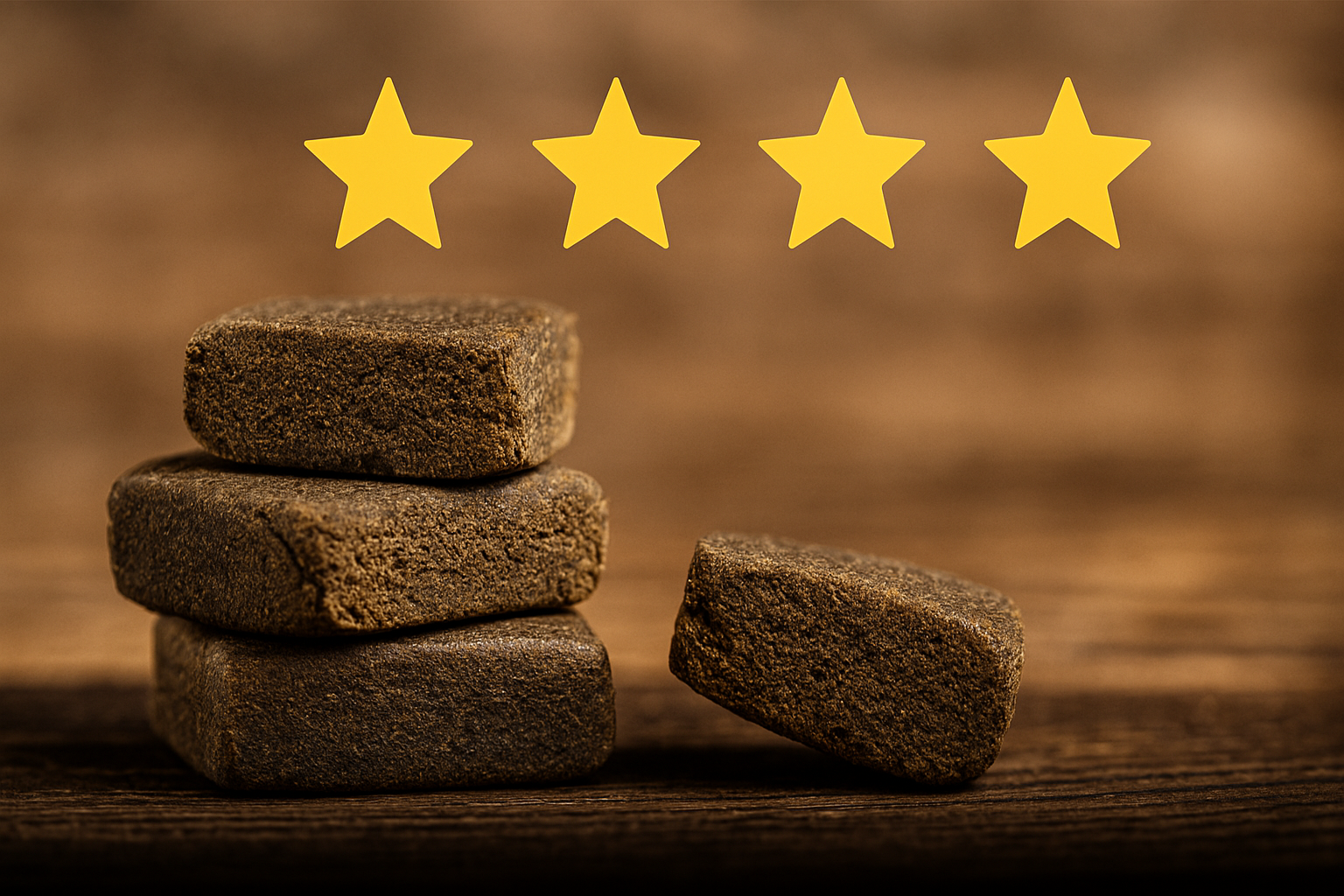
Following the developments in the hemp industry, it is useful to understand what the stars used to rate certain types of hash mean and to what extent they can help distinguish different characteristics and quality levels.
In this article, we clearly explain what these ratings may represent, which technical and sensory aspects can be assessed, and how to interpret a star rating. It is important to bear in mind from the outset that there is no official, universal star-rating system applicable to all CBD hash: its meaning may vary depending on the producer, retailer, or rating system used.
Before going into detail, you can explore the different categories available at Iberohemp, where you will find information about various hemp-derived products.
Importance of Star Ratings in the CBD Hash Market
In a sector offering a wide variety of formats, stars can be used as a commercial reference to distinguish different qualities or characteristics of hash. However, this type of rating should be interpreted with caution.
There is currently no official standard establishing that all one-, two-, three-, four-, or five-star hash products must meet exactly the same requirements. For this reason, two manufacturers may use the same number of stars while applying different criteria.
This type of classification can be useful when the brand clearly explains which parameters it uses to assign each category. These may include the proportion of resinous material, appearance, texture, aromatic profile, production method, or certain analytical results.
Therefore, rather than interpreting stars as an independent certification, they should be considered a complementary reference alongside traceability, technical product information, and batch analysis.
Key Factors That Can Influence a Hash Rating
When a producer or retailer establishes different quality levels, the classification may take several criteria into account. It is important to consider both the characteristics of the starting material and the composition, appearance, texture, and aromatic profile of the final product.
Each of these factors provides different information. For this reason, the quality of a hash product should not be determined solely by its colour, texture, or cannabinoid percentage.
Composition and Proportion of Resinous Material
One aspect that may be considered when assessing hash is the proportion of trichomes and resinous material in relation to the plant material present. The result will depend on the raw material and the method used to separate and process the resin.
Laboratory analyses can also determine the cannabinoid concentration of a batch. Analytical techniques such as high-performance liquid chromatography (HPLC) are commonly used to quantify certain cannabinoids.
Assessing potential contaminants requires specific tests depending on what needs to be detected. Parameters that may be analysed include heavy metals, pesticides, microorganisms, mycotoxins, or residual solvents, where relevant to the production method.
However, there is no universal percentage of “pure resin” that automatically makes a hash product a four- or five-star product. A statement such as “more than 60% resin equals four stars” would only be valid within a specific rating system that explicitly defines this criterion.
Colour and Texture
Visual and tactile assessment can provide descriptive information about CBD hash, although appearance alone cannot conclusively determine its quality.
Colours can vary considerably depending on the hemp variety, material used, resin separation method, pressure, temperature, storage conditions, and subsequent processing.
Likewise, products may have more compact, brittle, sandy, malleable, or resinous textures. Therefore, there is no single colour or texture that can universally be considered a sign of the highest quality.
In a comparative assessment, however, the homogeneity of the product can be examined, along with any visible alterations or characteristics that do not match the specifications declared by the manufacturer.
Aroma and Organoleptic Profile
The aromatic profile is another descriptive criterion that may be used to differentiate products. Depending on the hemp variety and its composition of volatile compounds, citrus, earthy, floral, resinous, woody, or spicy notes may be found, among many others.
A sensory assessment may consider aspects such as the intensity, definition, complexity, and persistence of the aroma, always from a purely descriptive perspective.
These characteristics should not be used to attribute medical, therapeutic, or wellness benefits to the product. Furthermore, a more intense or complex aroma does not automatically imply higher analytical quality.
Methods and Criteria for Assigning Stars to CBD Hash
The star ratings found on the market do not follow a single internationally standardised protocol. Producers, retailers, and specialist communities may use their own systems to distinguish quality levels, but their criteria can vary.
For this reason, it would not be accurate to claim that there is an independent organisation or European certification that generally establishes an official one-to-five-star scale for all CBD hash.
A classification is more transparent when the party responsible for the product explains which parameters are used and supports commercial information with verifiable data, batch analyses, and clearly defined assessment criteria.
One-to-Five-Star Scales
A brand may use a five-level scale to organise its catalogue. As an illustrative example of an internal classification, it could be structured as follows:
- 1 star: entry level within the system defined by the manufacturer or retailer.
- 2 stars: lower-intermediate category with specifications above the previous level according to the established criteria.
- 3 stars: intermediate level with balanced characteristics within the classification.
- 4 stars: higher category based on parameters such as raw material, homogeneity, aromatic profile, or production process.
- 5 stars: highest level within that specific scale, reserved for products that meet the most demanding requirements defined by the party establishing the classification.
This description does not constitute an official industry standard. To interpret a star scale correctly, it is necessary to understand the specific criteria used by the company applying it.
Laboratory Testing and Sensory Assessment
Laboratory analyses can complement a commercial classification by providing objective data on certain product parameters.
Depending on the tests performed, a certificate may include information on cannabinoids and different types of contaminants. These tests provide specific information about the sample or batch analysed, but they do not independently assign a universal number of stars.
Separately, a sensory assessment can describe characteristics such as appearance, texture, and aromatic intensity or complexity.
Combining analytical information with sensory criteria can provide a more complete description of the product, provided that the methodology and meaning of each rating are clearly explained.
Practical Interpretation of Each Star Level
A star scale can help organise different products within a catalogue, but its meaning always depends on the system being used.
Therefore, before comparing two products according to their star ratings, it is advisable to check whether they come from the same manufacturer or use exactly the same criteria. A four-star product from one brand does not necessarily correspond to a four-star product from another manufacturer.
What Does Each Star Range Mean?
Within a clearly explained commercial rating system, the different levels could represent a progression in aspects such as:
- 1–2 stars: entry-level categories within the particular classification used.
- 3 stars: intermediate level according to the parameters established by the brand.
- 4 stars: higher category with more demanding specifications within the same system.
- 5 stars: highest classification defined by the manufacturer or retailer for that particular range.
What matters is not only the number of stars, but the specific conditions a product must meet to receive them.
Selection Guide Based on Your Priorities
Before choosing a format, it is advisable to review its characteristics, composition, presentation, traceability, and available documentation.
If the aromatic profile is an important criterion, information about terpenes and the sensory characteristics of the batch may be useful. If you want to understand its composition, the relevant information will be the analytical results and declared cannabinoid profile.
You can also explore the CBD hash range from Iberohemp to compare different products and their characteristics.
In any case, a high star rating is not a substitute for technical product information.
International Differences in Hash Ratings
The ways in which hash is described and classified can vary between producers, markets, and production traditions. Precisely because there is no single international star-rating scale, terminology used in different countries is not always directly comparable.
Factors such as the size of the separated trichomes, production method, appearance, texture, or physical characteristics of certain traditional types of hash may form part of specific classification systems.
It is also important to avoid a common oversimplification concerning THC. The 0.3% THC threshold in European regulations does not, by itself, constitute a general limit automatically applicable to every finished CBD product.
In the European Union, the 0.3% figure appears in specific provisions relating, among other matters, to certain hemp varieties and cultivation requirements under the Common Agricultural Policy and to certain imports. In addition, Member States may establish additional or more restrictive requirements.
Therefore, the compliance of a specific product should be assessed according to its nature, presentation, intended use, and the regulations applicable in the market where it is sold.
How to Use Star Ratings to Assess Hash More Effectively
Stars can be useful as a quick reference, provided that you understand the criteria behind the classification.
For a more informed comparison, it is advisable to review product information, available traceability data and, where applicable, laboratory reports. If the aromatic profile is particularly relevant, the declared sensory characteristics can be considered; if the aim is to understand composition, it is preferable to focus on the analytical data for the batch.
You can also explore premium CBD flowers to learn about other hemp-derived formats and compare their respective characteristics.
Ultimately, stars used to rate hash should be understood as a reference system whose usefulness depends on the transparency of the criteria applied. On their own, they do not constitute an official certification and cannot automatically determine the composition or quality of a product.
The most reliable way to interpret a rating is to combine it with information about the raw material, production method, composition, traceability, and available analyses.


Leave a comment
This site is protected by hCaptcha and the hCaptcha Privacy Policy and Terms of Service apply.