

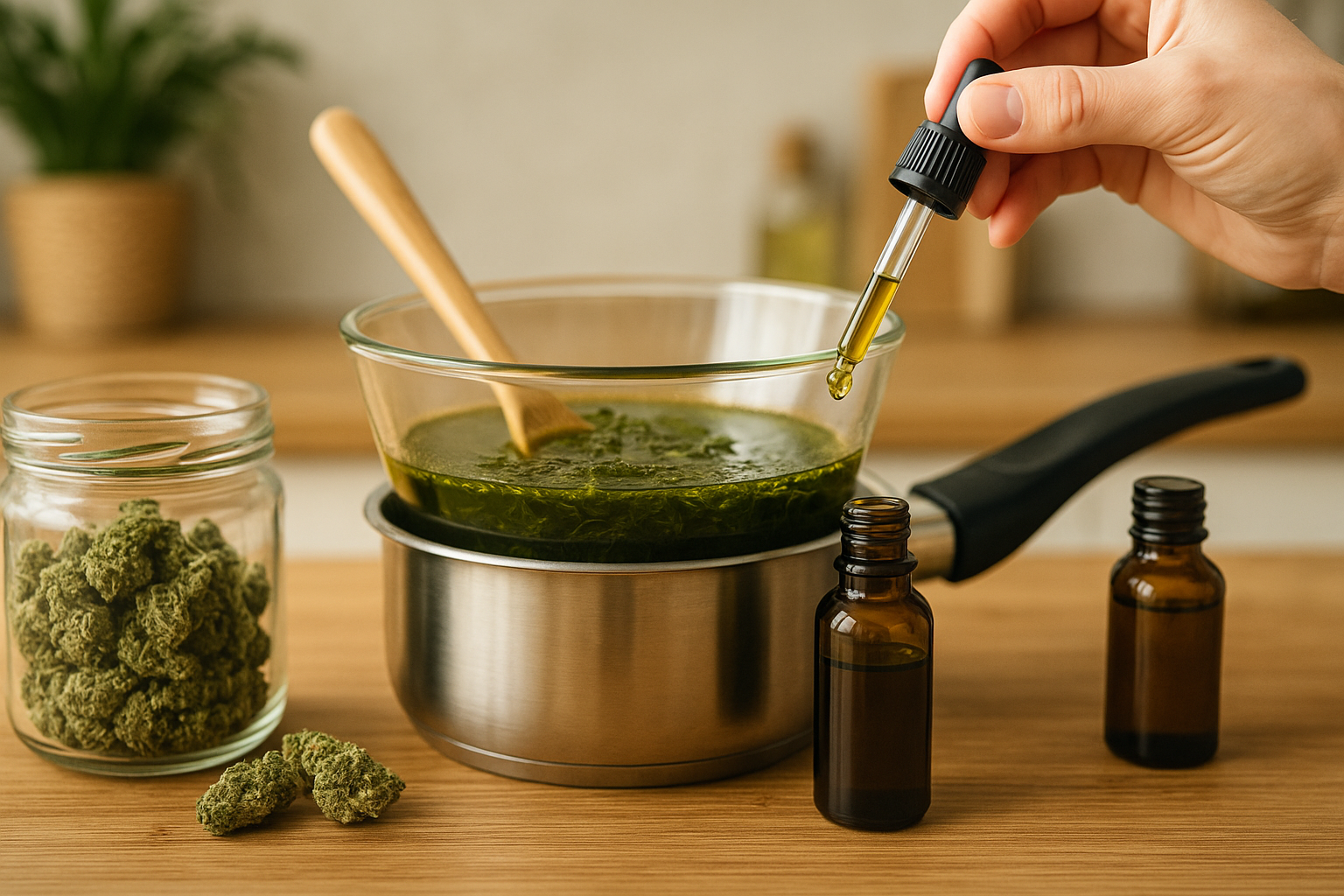

Welcome to our guide on how to make homemade CBD oil, where you will discover a simple and safe process to prepare your own formulation with quality hemp. In this article, we guide you step by step, from selecting the raw material to the final bottling, always with a practical and accessible approach. To ensure excellent results, we will use premium CBD flowers and legal hemp hash, with THC below 0.3%, available in our online store. Throughout the text, you will find direct links to Iberohemp products that will optimise your experience and allow you to complete your homemade method smoothly.
Why choose a homemade process for your CBD oil
Choosing a homemade process for your CBD oil gives you full control over every stage and ensures the purity of the extract. By making your own oil, you avoid unnecessary additives, artificial preservatives and generic mass-market formulas. This level of supervision guarantees a terpene and cannabinoid profile personalised according to your preferences, strengthening confidence in the quality of the product. In addition, carrying out the extraction at home results in a more competitive cost per milligram of CBD and allows you to prepare adjusted doses.
List of necessary ingredients and utensils
To prepare your homemade CBD oil, gather premium CBD flowers or CBD hash with a THC content below 0.3%, both available on our website. You will also need a neutral carrier oil such as extra virgin olive oil, heat-resistant glass utensils, a fine grinder, a mesh filter or cheesecloth, and a digital thermometer. A bain-marie or an adjustable-temperature hot plate will make controlled infusions easier. Having a dark glass container for final storage will complete your homemade kit. Keeping these elements at hand will help you avoid setbacks and maximise the efficiency of the procedure.
CBD extraction methods: advantages and disadvantages
There are three main techniques for making homemade CBD oil, each with its strengths and limitations. Below, we go into each method in more detail, helping you decide which one best suits your experience, equipment and CBD concentration goals. We will assess smoothness, preparation time and safety requirements, guiding you towards the most suitable option according to your skill level and the resources available at home.
Maceration in carrier oil
Maceration in carrier oil is the most accessible technique for beginners. It consists of soaking the crushed plant material in olive oil at a low temperature for several hours, allowing the cannabinoids to dissolve gradually. This gentle method avoids the denaturation of terpenes and keeps the aromatic profile of the CBD flowers intact. Although the infusion time is longer than in other procedures, the simplicity of the technique and the absence of aggressive solvents make it a recommended option for those seeking a purely natural process without the risk of evaporation of active compounds.
Infusion with controlled heat
Infusion with controlled heat speeds up extraction by keeping the mixture of hemp and carrier oil within an optimal thermal range of 60 °C to 80 °C. Using a bain-marie or a hot plate with a thermostat, the temperature is regulated to optimise CBD transfer without degrading volatile components. The cooking time, between 2 and 4 hours, is adjusted according to the fineness of the raw material and the desired concentration. This method offers a balance between speed and quality, ensuring a dense and aromatic oil, ideal for those with basic equipment who want professional results.
Alcohol extraction
Alcohol extraction, generally using food-grade ethanol, is known for its speed and high efficiency in capturing cannabinoids and terpenes. After decarboxylating the hemp, it is dissolved in alcohol and the solution is filtered before evaporating the solvent at low temperature. This procedure, although it requires ventilation precautions and careful handling of flammable materials, provides a concentrated extract in just a few hours. It is crucial to completely remove any alcohol residue to ensure the purity of the oil, so it is recommended to have distillation equipment or use hot plates with precise temperature control.
Step-by-step guide to preparing your homemade CBD oil
In this section, we detail each phase of the process so that you can make your homemade CBD oil with confidence. From initial preparation to final bottling, we explain the critical points, recommended temperatures and resting times. By following these instructions, you will obtain a high-quality product with a consistent profile and uniform potency. Always maintain good ventilation and use clean utensils to avoid contamination.
Preparing the raw material
The first step in creating homemade CBD oil is to decarboxylate the CBD flowers or hash. Spread the crumbled plant material on a baking tray and heat it at 110 °C for 30–40 minutes, stirring every 10 minutes. This process activates the cannabinoids, optimising their solubility in the carrier oil. A fine grind increases the contact surface, improving extraction. Make sure the material is completely dry before starting the infusion to prevent mould or bacteria from forming during resting.
Extraction and filtering process
Once decarboxylated, combine the raw material with the carrier oil in a glass container. If you choose maceration, let it infuse at 60 °C for 6–8 hours; for accelerated infusion, keep the temperature between 70 °C and 80 °C for 2 to 4 hours; and if you choose alcohol, dissolve, filter and evaporate carefully. Once finished, filter the liquid using cheesecloth or a fine mesh strainer, squeezing well to extract all the oil. Carry out a second filtering if necessary to ensure a clean product free of plant residues.
Dosage and bottling
To calculate the concentration of your oil, record the amount of CBD present in the raw material and the volume of oil used. Mix well and adjust the dose by adding more carrier oil if you are looking for a lower concentration. Once ready, transfer the oil into dark glass dropper bottles, avoiding direct exposure to light and oxygen. Label each container with the production date and the approximate concentration per millilitre. To explore professional packaging options, visit our collection of CBD oils.
Tips for storing and preserving your CBD oil
Homemade CBD oil maintains its potency and aroma when stored under suitable conditions. Keep the bottles in a cool, dark place, with a stable temperature between 15 °C and 20 °C. Avoid prolonged contact with light and air, as they promote oxidation and terpene loss. If you have bottles with airtight droppers, they reduce oxygen intake and extend the shelf life of the oil. Periodically check the sensory quality and, if you notice any change in smell or colour, discard the content to always ensure an optimal profile.
Common mistakes when making homemade CBD oil and how to avoid them
One of the most frequent mistakes is incomplete decarboxylation, which reduces extraction efficiency. Control the oven temperature and baking time to avoid this problem. Another common error is filtering with mesh that is too coarse, leaving plant residues that cloud the oil. Use fine cloth filters or filter paper. Likewise, raising the temperature too much during alcohol evaporation can degrade sensitive compounds. Maintain a constant thermal range and document each batch to replicate the best results.
Usage ideas and combinations with other products
Homemade CBD oil can be easily integrated into your personal care routine. You can mix a few drops with your favourite facial cream to enrich its texture and enjoy a silkier finish. It is also an excellent complement in homemade cosmetic preparations, such as serums and massage balms. For a more intense aroma, combine your homemade oil with a few drops of natural essential oils. Experiment with different proportions until you find the formula that best suits your aesthetic and sensory preferences.
How to make homemade CBD oil: final recommendations for optimal results
To achieve superior-quality homemade CBD oil, we recommend using exclusively premium CBD flowers and CBD hash from our selection, guaranteeing raw material with THC below 0.3%. Document every step, from decarboxylation to bottling, and refine your technique batch after batch. We invite you to try our offer and share your experiences to keep perfecting this homemade craft.


Leave a comment
This site is protected by hCaptcha and the hCaptcha Privacy Policy and Terms of Service apply.