

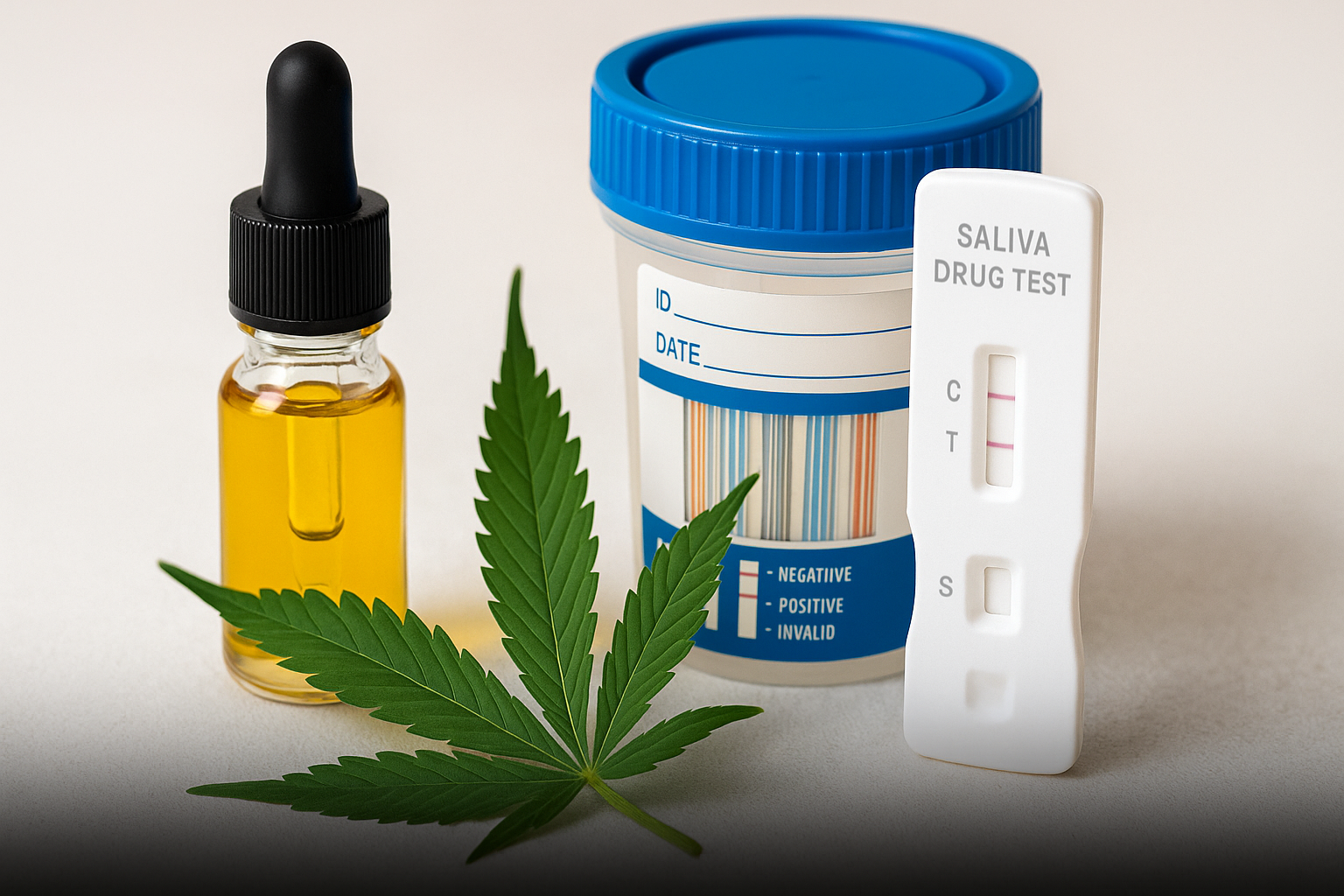

At Iberohemp, we know that one of the most common questions among legal hemp consumers is whether “CBD shows up positive in a saliva test”. This concern arises especially in work contexts, routine checks or situations where drug detection tests are required. Although cannabidiol is not a controlled or psychoactive substance, the lack of clear information about how these tests work creates uncertainty and, in some cases, misunderstandings.
In this article, we rigorously analyse how saliva and urine tests operate, what substances they actually aim to detect and why, in very specific circumstances, unexpected results may occur. We also address the technical and biological factors that influence the analysis, as well as a series of practical recommendations aimed at reducing risks and avoiding confusion. The goal is to offer a clear explanation, based on technical and scientific criteria, that helps understand when there is really a possibility of a positive result and when it is an unfounded myth.
How saliva and urine analyses work to detect cannabinoids
Saliva and urine tests are based on identifying traces of metabolites derived from cannabinoid exposure. In both cases, the technology combines immunoenzymatic methods with confirmations by chromatography and mass spectrometry. While saliva detects unmetabolised compounds shortly after exposure, urine reveals metabolites over several days. Understanding these technical and scientific foundations is key to knowing why “CBD shows up positive in a saliva test” only in very specific circumstances and with poorly analysed products.
Detection principle in saliva
Saliva devices use reactive strips that incorporate specific antibodies capable of binding to unprocessed cannabinoid molecules. When the sample comes into contact with the reagent, a colour change is generated, indicating the presence of compounds. For confirmation, liquid chromatography coupled with mass spectrometry is used, validating the initial result and reducing false positives. The detection window is short, which makes it essential to follow the sampling procedure correctly.
Processing of metabolites in urine
In urine, the analysis focuses on hydroxylated and conjugated metabolites after hepatic biotransformation. After collection, the sample undergoes hydrolysis, extraction and analyte concentration. An immunoassay detects the presence of metabolites, which are then confirmed by gas chromatography with mass spectrometry. This technical combination provides high sensitivity for cannabinoid traces up to several days after the initial exposure.
Factors that influence whether CBD shows up positive in a saliva test
Although cannabidiol (CBD) does not appear in most standard drug tests, several factors may trigger an unexpected result. Method sensitivity, possible cross-contamination with THC and individual metabolic variability play a decisive role. Knowing these variables allows us to ensure that our products with THC below 0.3% meet strict quality controls and avoid surprises in work environments or routine checks.
Test sensitivity and specificity
Sensitivity measures the ability to detect minimal doses of an analyte, while specificity indicates the ability to distinguish between similar substances. In some rapid saliva kits, the cut-off threshold may be configured for THC metabolites, but poorly selective antibodies could react with traces of CBD. That is why it is essential to choose validated tests and rely on laboratory confirmation to reduce the likelihood of detecting “false positives”.
Cross-contamination and traces in products
During extraction or packaging, THC residues may contaminate CBD batches if the equipment is not properly cleaned. This cross-contamination can slightly raise THC levels up to the detection limit of some tests. Our recommendation is to always purchase certified products, such as our premium CBD flowers, produced under processes that prevent any trace unrelated to authorised hemp.
Individual metabolic variation
Each body processes cannabinoids at different rates depending on genetics, urinary pH and liver function. These physiological differences can prolong or shorten the presence of metabolites in urine and saliva. Although CBD showing up positive in a saliva test is highly unlikely with pure products, users with slower metabolism may retain metabolites for longer, which is why choosing extracts with certified analytical controls is important.
Detection window in saliva vs urine: times and variations
Knowing how long cannabinoids remain detectable is essential when planning job interviews or high-risk activities. Saliva offers a short detection period, while urine extends that timeframe. Below are approximate ranges that help explain why a saliva test is less invasive but more limited in time compared with the broader coverage of urine.
Approximate detection time in saliva
Saliva can reveal traces of cannabinoids between 1 and 24 hours after exposure, although in occasional users the range is usually reduced to 4–6 hours. Given this interval, saliva testing is useful for detecting recent exposure, but does not provide information about past exposure. Using highly specific kits minimises the possibility of CBD showing up positive in a saliva test with legal hemp products.
Duration of traces in urine
In urine, hydroxylated metabolites can be detected from 2 to 7 days afterwards, and even longer in regular users. This broad period makes urine testing a stricter method for periodic checks. However, the purity of a CBD oil with THC below 0.3% and hygiene protocols can reduce the risk of metabolites appearing in urine analysis practically to zero.
Myths and realities about whether CBD shows up positive in a saliva test
In the CBD sector, many beliefs circulate without scientific support. Debunking these myths provides clarity and confidence. It is sometimes claimed that any CBD oil or flower will cause a positive saliva result; however, this claim does not hold up when products have been analysed and certified. Below, we compare real risks with the available evidence.
Real risk of a false positive
Studies indicate that saliva kits have false positive rates below 2% when used correctly. That probability decreases even further with laboratory confirmations. Therefore, the uncertainty over whether CBD shows up positive in a saliva test exists, but it is remote when products with analytical controls and approved equipment are used.
Available scientific evidence
Research published in toxicology journals highlights that CBD does not react with antibodies designed for THC metabolites. Only impurities or high THC concentrations can generate signals in saliva tests. These reports support the choice of broad-spectrum CBD oils, such as those we offer, with guaranteed cannabinoid content and no relevant THC.
Good practices to minimise an unexpected positive result
To reduce any risk as much as possible, we recommend three key actions: selecting highly reliable tests, adopting hygiene protocols before sampling and verifying product purity. These measures strengthen confidence in work environments and prevent surprises during checks. They also make it easier to comply with strict company policies regarding cannabinoids.
Selecting tests with high specificity
Choosing detection kits with high specificity is a key factor in minimising erroneous results. The most reliable tests are those with selective antibodies for THC metabolites and which, in the event of a positive result, allow subsequent confirmation through laboratory analysis. Choosing this type of test significantly reduces the risk of CBD showing up positive in a saliva test, especially when legal hemp products with THC contents within permitted limits are used.
Oral hygiene protocols before the test
Rinsing with water and gently brushing teeth and tongue at least 15 minutes before taking the sample reduces residues in the mouth. Avoiding foods with CBD residues in the hours before also helps. These simple practices help ensure that detection corresponds exclusively to circulating metabolites and not to surface residues in saliva.
Review of ingredients and contaminants
Before buying a product, it is advisable to request certificates of analysis that verify cannabinoid content and absence of contaminants. In our online store, we offer CBD oils, CBD flowers and CBD hash with third-party reports guaranteeing THC below 0.3%. Reviewing these documents is the best defence against an unexpected positive result.
Legal and workplace aspects after a positive saliva or urine test
Obtaining a positive result can have professional consequences and requires timely legal action. Understanding the current regulatory framework and possible sanctions in employment contracts or internal policies is essential to prepare an appropriate defence. Below, we describe the most common scenarios and recommended actions.
Consequences in the workplace
Many companies consider disciplinary measures according to their internal substance-use policy. A positive saliva or urine test can result in warnings, suspension from work or even dismissal, depending on the collective agreement. Having purity certificates and confirmation protocols helps argue that any finding does not come from illicit use.
Basic legal recommendations
In case of discrepancies, it is advisable to request a repeat test in an accredited laboratory and seek advice from a professional specialised in employment law. Documenting the origin of CBD products and presenting analysis reports can overturn sanctions. Having a lawyer or external adviser increases the strength of the defence and minimises the risk of unfair application of internal regulations.
Recap and next steps after knowing whether CBD shows up positive in a saliva test
Throughout the article, we have seen that cannabidiol is not, by itself, a substance that standard drug tests are designed to detect. The possibility that CBD may show up positive in a saliva test is rare and is usually associated with very specific situations, such as the presence of impurities, residual traces of THC or failures in the sampling and analysis procedure. For this reason, it is essential to understand how these tests work and what factors may influence their result to avoid misinterpretations.
To minimise any risk, it is advisable to adopt a preventive approach based on three pillars: verifying the origin and analytical certification of hemp products, following basic hygiene guidelines before the test and, whenever possible, choosing tests that include a laboratory confirmation phase. These measures not only increase result reliability, but also provide greater security in work environments or situations where a positive analysis may have relevant consequences.
Ultimately, having clear information and acting with judgement makes it possible to reduce uncertainty and make responsible decisions. Understanding when there is a real risk and when it is a false alarm is the first step towards dealing with this type of control calmly and well informed.


Leave a comment
This site is protected by hCaptcha and the hCaptcha Privacy Policy and Terms of Service apply.