

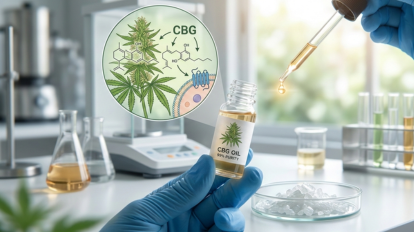

CBG (cannabigerol) is one of the many natural compounds found in the Cannabis sativa plant, commonly known as cannabis or hemp. Although scientific and media attention has focused mainly for decades on cannabinoids such as THC or CBD, CBG has begun to attract interest in scientific research due to its fundamental role in cannabis chemistry.
In fact, CBG is considered the “mother cannabinoid”, as it acts as a precursor to other important cannabinoids. Without this molecule, well-known compounds such as CBD or THC simply would not exist in the plant.
In this complete guide, we explain what CBG is, how it forms in the cannabis plant, why it is present in small amounts and what its importance is within the complex system of natural cannabinoids.
What is CBG?
Cannabigerol (CBG) is a phytocannabinoid, meaning a cannabinoid naturally produced by the cannabis plant.
Cannabinoids are chemical compounds that interact with the human body’s endocannabinoid system, a biological system involved in multiple physiological processes. More than 100 different cannabinoids have been identified in the cannabis plant, including:
- THC (tetrahydrocannabinol)
- CBD (cannabidiol)
- CBN (cannabinol)
- CBC (cannabichromene)
- CBG (cannabigerol)
Unlike THC, CBG is not a psychoactive compound, which means it does not produce intoxicating effects associated with cannabis. As explained in a scientific review on the chemical diversity of cannabinoids present in the cannabis plant, these compounds form a broad family of natural metabolites produced by Cannabis sativa.
Where CBG is found in the plant
CBG appears naturally in all cannabis varieties, although generally in very low concentrations.
In most mature cannabis or hemp plants, CBG represents less than 1% of the total cannabinoid content. This is because, during plant development, this compound is transformed into other more abundant cannabinoids.
Why CBG is considered a minor cannabinoid
In scientific cannabis research, cannabinoids are usually classified as:
- Major cannabinoids: THC and CBD
- Minor cannabinoids: CBG, CBN, CBC and others
CBG is considered a minor cannabinoid not because of its biological importance, but because it appears in relatively small amounts in the mature plant.
Origin and discovery of CBG
Cannabigerol was first identified in 1964 by researchers Raphael Mechoulam and Yehiel Gaoni, two pioneering scientists in the study of cannabis. Their work made it possible to isolate several cannabinoids present in cannabis resin and laid the foundations for modern research on this plant.
The original study on the isolation of cannabinoids can be consulted in the scientific database PubMed, one of the world’s main biomedical literature platforms. Mechoulam’s research is considered fundamental for understanding cannabis chemistry and has influenced decades of subsequent research.
Following this discovery, scientific interest in cannabinoids began to grow significantly. Over the following decades, numerous researchers expanded knowledge about the chemical composition of cannabis and the processes through which the plant produces these compounds. This progress made it possible to better understand the role of CBG within cannabinoid biosynthesis and its importance as a precursor to key compounds such as CBD or THC.
CBG as a precursor to other cannabinoids
One of the most interesting aspects of CBG is that it acts as a chemical precursor to many other cannabinoids present in the plant. For this reason, it is often called the “mother cannabinoid”, as it participates in the early stages of the formation of several of the best-known cannabis compounds.
In reality, the initial compound is not CBG itself, but its acidic form: cannabigerolic acid (CBGA). This molecule is produced in the early stages of plant development and serves as a starting point for the synthesis of other cannabinoids. As the cannabis plant develops, different enzymes transform CBGA into other acidic cannabinoids, such as THCA, CBDA or CBCA. These compounds are the direct precursors of better-known cannabinoids such as THC, CBD or CBC.
Because of this central role in cannabinoid biosynthesis, CBG occupies a key position within cannabis chemistry and is considered one of the most important compounds for understanding how different cannabinoids develop in the plant.
What is CBGA?
CBGA is the molecule from which several of the best-known cannabis cannabinoids are synthesised.
During plant development, CBGA can be converted into:
- THCA (tetrahydrocannabinolic acid)
- CBDA (cannabidiolic acid)
- CBCA (cannabichromenic acid)
Later, through processes such as heat or ageing, these acidic forms are transformed into their neutral versions known as THC, CBD or CBC.
This process is part of cannabinoid biosynthesis, a key phenomenon in cannabis biology, as described by various scientific studies on phytocannabinoids and their biosynthesis in the cannabis plant.
How CBG forms in the cannabis plant
The production of cannabinoids in the cannabis plant is the result of a complex series of chemical reactions controlled by enzymes.
Cannabinoid biosynthesis
The process begins with two precursor molecules:
- Geranyl pyrophosphate
- Olivetolic acid
These molecules combine to form CBGA, which can later be transformed into other cannabinoids.
This biochemical process has been documented in studies on cannabis biosynthesis published by the National Center for Biotechnology Information (NCBI).
The role of synthase enzymes
The conversion of CBGA into other cannabinoids depends on specific enzymes known as synthases, including:
- THCA synthase
- CBDA synthase
- CBCA synthase
Each one directs the chemical reaction towards the production of a different cannabinoid.
How much CBG the cannabis plant contains
In most cannabis or industrial hemp varieties, CBG appears in concentrations below 1%.
This occurs because CBGA quickly transforms into other cannabinoids as the plant matures.
Why CBG decreases over time
During the early stages of plant growth, CBGA is present in higher amounts. However, as the plant develops, the enzymes mentioned above convert it into other cannabinoids.
As a result of this natural process, CBG usually remains present only in small amounts in the mature plant. For this reason, it has historically been considered a minor cannabinoid within the chemical profile of cannabis.
New CBG-rich varieties
In recent years, researchers and growers have developed CBG-rich cannabis varieties through genetic selection.
Some of these varieties can contain up to 10–15% CBG, which facilitates its study and extraction. These advances have driven scientific interest in this cannabinoid.
How CBG is extracted
CBG can be obtained from the cannabis plant using techniques similar to those used for other cannabinoids.
The most commonly used methods include:
- supercritical CO₂ extraction
- ethanol extraction
- chromatography processes
Supercritical CO₂ extraction
One of the most widely used methods in the industry is supercritical carbon dioxide extraction, a technique that allows the active compounds of the plant to be separated with great precision.
This method makes it possible to obtain cannabinoid extracts with high levels of purity and has been analysed in research on cannabinoid extraction using supercritical CO₂ published in the scientific journal Processes.
Chromatography to isolate cannabinoids
After the initial extraction, chromatography techniques can be used to isolate specific cannabinoids, including CBG. This process makes it possible to separate the different compounds present in the cannabis extract.
Chromatography is a technique widely used in analytical chemistry that separates molecules according to their physical and chemical properties, such as molecular weight or affinity with certain solvents. In cannabis, these techniques are used to differentiate and purify the different cannabinoids present in the extract.
Among the most commonly used methods are high-performance liquid chromatography (HPLC) and other variants of preparative chromatography, which make it possible to obtain individual compounds with high levels of purity. Thanks to these processes, it is possible to isolate specific cannabinoids such as CBG from complex extracts containing numerous plant compounds.
Why CBG is more difficult and expensive to produce
One reason why CBG is less common on the market than other cannabinoids is its production complexity. Unlike compounds such as CBD, which can be found in relatively high concentrations in certain hemp varieties, CBG is usually present in much smaller amounts, making its production more costly and technically demanding.
Low natural concentration
As mentioned above, most plants contain very little CBG, which means that a larger amount of plant biomass is needed to obtain it. In many cases, the CBG content in the mature plant is below 1%, requiring large volumes of plant material to be processed in order to obtain significant amounts of this cannabinoid.
Specialised cultivation
Some companies use CBG-rich cannabis varieties harvested before CBGA transforms into other cannabinoids. This makes it possible to obtain higher concentrations of this compound.
These varieties have been developed through genetic selection and specialised cultivation programmes designed specifically to maximise the presence of CBG in the plant.
More complex purification processes
The separation of CBG usually requires additional purification processes, which can increase production cost. After the initial extraction, cannabis extracts contain multiple cannabinoids and other plant compounds, so refining and analysis techniques must be applied to isolate CBG with a high degree of purity.
Differences between CBG and other cannabinoids
Cannabis contains a wide diversity of cannabinoids, each with specific chemical characteristics. These compounds form part of the plant’s chemical profile and are generated through different biosynthesis processes during cannabis growth and development.
CBG vs CBD
CBD is one of the most abundant cannabinoids in industrial hemp, while CBG appears in much smaller amounts. In addition, CBG acts as a precursor to CBD during cannabinoid biosynthesis.
From a chemical point of view, both compounds have similar molecular structures, but they originate at different stages of plant development. CBD forms from cannabidiolic acid (CBDA), while this compound in turn comes from CBGA, the central precursor molecule in cannabinoid biosynthesis.
CBG vs THC
THC is the cannabinoid responsible for the psychoactive effects of cannabis. CBG, by contrast, does not produce intoxicating effects.
In addition, both compounds originate from different biosynthetic pathways within the plant. While THC comes from tetrahydrocannabinolic acid (THCA), this compound also derives from CBGA in the early stages of cannabis development.
CBG compared with other minor cannabinoids
Other less abundant cannabinoids include:
- CBN
- CBC
- CBDV
- THCV
Each one has different chemical structures and is produced at different stages of plant development. Some appear as a result of natural chemical transformations that occur over time, while others are generated from different metabolic pathways within the cannabis plant.
Although they are found in lower concentrations, these cannabinoids form part of the complex chemical profile of cannabis and contribute to the diversity of compounds produced by this plant.
How cannabinoids interact with the endocannabinoid system
Cannabinoids can interact with the endocannabinoid system, a biological system present in the human body that participates in the regulation of numerous physiological processes. This system forms part of the body’s natural cellular communication mechanisms and plays an important role in maintaining internal balance.
What is the endocannabinoid system?
The endocannabinoid system was identified by researchers in the 1990s while studying how cannabis compounds interact with the body. This system is mainly composed of cellular receptors, endogenous molecules known as endocannabinoids and various enzymes responsible for their synthesis and degradation.
A detailed description of the structure and functioning of the endocannabinoid system can be consulted in the medical library of the National Institutes of Health (NIH).
CB1 and CB2 receptors
The two best-known receptors in this system are:
- CB1, mainly present in the nervous system
- CB2, mainly associated with the immune system
These receptors act as interaction points for different molecules in the body. Phytocannabinoids present in the cannabis plant, such as CBG, CBD or THC, can interact with these receptors in different ways, which explains the scientific interest in studying these compounds and their relationship with the endocannabinoid system.
The future of CBG research
Scientific interest in cannabinoids has increased significantly over recent decades. As knowledge of cannabis chemistry has advanced, researchers have begun to pay greater attention to less abundant cannabinoids, such as CBG, which for a long time went relatively unnoticed.
CBG, in particular, has become an emerging area of research due to its fundamental role in cannabis chemistry. As a precursor to other important cannabinoids, this compound occupies a key position within the biosynthesis of phytocannabinoids produced by the plant.
Current areas of study include:
- its biosynthesis in the plant
- new CBG-rich varieties
- more efficient extraction methods
- possible applications in pharmacological research
In addition, advances in cannabis genetics are making it possible to develop new varieties with higher concentrations of CBG. This facilitates its study and opens new possibilities for better understanding how this cannabinoid is produced and what role it plays within the plant’s chemical profile.
At the same time, the development of new analytical and extraction techniques is helping isolate individual cannabinoids with greater precision, allowing researchers to study their chemical properties in more detail. As scientific research progresses, new aspects of this cannabinoid and its role within the complex chemical ecosystem of cannabis are likely to be discovered.
Frequently asked questions about CBG
Is CBG psychoactive?
No. CBG does not produce psychoactive effects associated with THC. This means it does not generate the sensations of intoxication or mental alteration commonly associated with some cannabis-derived products.
What is the difference between CBG and CBD?
CBG is a chemical precursor to CBD during cannabinoid biosynthesis in the plant. While CBD is usually found in relatively high concentrations in certain hemp varieties, CBG is usually present in much smaller amounts because much of the CBGA is transformed into other cannabinoids as the plant matures.
Is CBG present in all cannabis plants?
Yes. CBG appears in all cannabis varieties, although generally in very small amounts.
Why is there less CBG than CBD?
Because during plant development, CBG is transformed into other cannabinoids such as CBD or THC. This process is part of the natural biosynthesis of cannabinoids, in which CBGA acts as a precursor molecule for several compounds present in cannabis.
Where is CBG obtained from?
CBG is obtained through extraction processes from the cannabis plant or from hemp varieties specially cultivated to produce higher amounts of this cannabinoid. In recent years, CBG-rich cannabis varieties have been developed to increase its concentration and facilitate its extraction for research and new product development.


Leave a comment
This site is protected by hCaptcha and the hCaptcha Privacy Policy and Terms of Service apply.