

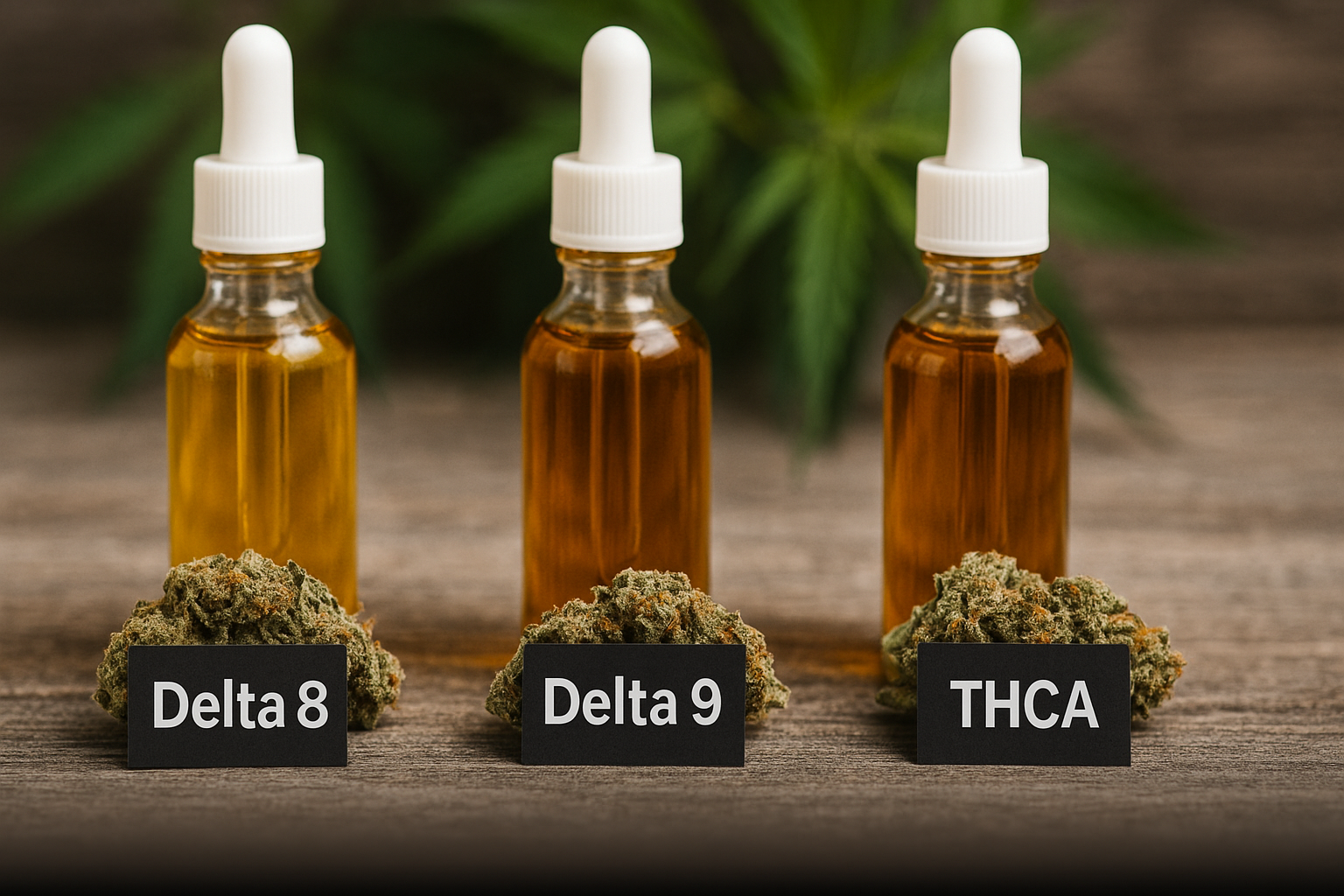
In this article, we analyse in detail the differences between delta-8, delta-9 and THCA, three cannabis-derived compounds that often raise questions because of their similar names and origin, but which have different characteristics. Although they are chemically related, their behaviour and form of use are not exactly the same.
Throughout the text, we review their main properties, how they are obtained and what happens in each case from a chemical point of view. We also address issues such as purity levels, the forms in which they are presented on the market and the legal implications that may vary depending on the context. The goal is to offer a clear, organised explanation based on reliable information to better understand what sets each of these compounds apart.
What are Delta 8, Delta 9 and THCA? Context and general characteristics
Before going into the comparison of these three compounds, it is useful to define them. Delta 8 and Delta 9 are isomers of tetrahydrocannabinol found in the hemp plant, while THCA represents its natural acidic form. Understanding the chemical basis and stability of each compound is essential for evaluating extraction processes and industrial applications. This section establishes the fundamental concepts behind each variant, providing clarity and authority.
Definition of Delta 8
Delta-8-tetrahydrocannabinol (delta-8 THC) is a cannabinoid that differs from other THC isomers due to the position of its double bond in the molecular structure, specifically on carbon 8. Although this variation is subtle, it has an impact on its chemical properties and on the way it interacts with the body.
In nature, delta-8 appears in very small amounts in the cannabis plant. For this reason, most available delta-8 is obtained from the conversion of other cannabinoids, such as CBD or delta-9 THC itself, through controlled chemical processes in the laboratory.
Structurally, it is very similar to delta-9, but the shift in the double bond influences its stability and its affinity for receptors in the endocannabinoid system. This difference, although slight, is key to understanding its characteristics and distinguishing it from other related compounds.
Definition of Delta 9
Delta-9-tetrahydrocannabinol (delta-9 THC) is the best-known THC isomer and the main psychoactive compound present in the cannabis plant. It is characterised by the position of a double bond on carbon 9 of its molecular structure, an apparently small detail that directly influences its chemical and biological behaviour.
Unlike delta-8 THC, whose structural variation is located in another position, delta-9 has a greater affinity for receptors in the endocannabinoid system, especially CB1 receptors, which results in differences in how it interacts with the body. This variation in molecular configuration can also affect its stability and reactivity.
Therefore, although both compounds are closely related, this structural distinction is key to understanding their differences and correctly differentiating them from a chemical point of view.
Definition of THCA
Tetrahydrocannabinolic acid (THCA) is the acidic form of THC found naturally in fresh cannabis plants. It is the precursor compound of delta-9 THC and is present before the plant is exposed to heat or ageing.
In its raw state, THCA is a chemically stable molecule and does not present the same effects as THC. This stability is maintained during processes such as drying or storage, provided that direct heat is not applied.
When THCA is exposed to heat (decarboxylation), its chemical structure changes and it becomes delta-9 THC. It is at that point that it acquires psychoactive activity.
Therefore, although THCA and THC are closely related, the difference in their chemical structure is key to understanding their behaviour and effects.
Obtaining processes and purity
Analysing the obtaining processes and purity levels is essential to understand the quality of compounds such as delta-8, delta-9 and THCA. From the selection of raw material to laboratory controls, each stage directly influences the final concentration and the possible presence of impurities.
This section describes both natural sources and the main extraction and refining techniques used in the industry, with the aim of obtaining consistent products that are well characterised from a chemical point of view.
Natural sources and extraction methods
Cannabinoids are mainly obtained from cannabis or hemp plants grown under different agricultural standards. From this plant material, compounds are extracted using techniques such as supercritical CO₂, the use of ethanol or, to a lesser extent, cold pressing.
These methods allow cannabinoids to be isolated together with other compounds present in the plant, such as terpenes or waxes. Refining and purification processes are then applied to increase concentration and reduce impurities, especially in the case of compounds such as delta-8, which is usually obtained through conversion from other cannabinoids.
The final result depends largely on the quality of the raw material and the control applied throughout the process. A good analysis and traceability system is key to evaluating the purity and composition of the product obtained.
Refining techniques and quality controls
Cannabinoid refining includes fractional distillation, column chromatography and microfiltration to remove impurities and concentrate the desired isomer. Each batch undergoes laboratory analysis to certify levels of Delta 8, Delta 9 and THCA, as well as origin traceability.
Chemical aspects and molecular structure
Taking a closer look at the molecular structure of Delta 8, Delta 9 and THCA helps to understand their differences at an atomic level. This approach is aimed at readers with advanced knowledge who are looking for chemical details without losing clarity. We will analyse the position of the double bonds and the decarboxylation process that converts THCA into THC. This technical foundation reinforces authority and supports the informative rigour of the comparison.
Differences in double bonds and their impact
The shift of the double bond in Delta 8 compared with Delta 9 modifies its interaction affinity with receptors and its molecular stability. Although they share the same gross formula, the position in the eighth or ninth location influences its reactivity to heat and oxidation. These variations explain differences in user experience and in behaviour during extraction processes. Understanding this detail is key when comparing both isomers.
Decarboxylation of THCA into THC
Decarboxylation of THCA into THC occurs when moderate heat is applied, removing CO₂ and generating the active form of the cannabinoid. This process is used in the laboratory to transform the acidic precursor into its psychoactive isomer. Conversion efficiency depends on time and temperature, which are critical parameters in quality control before use in formulations.
Delta 8 vs Delta 9 vs THCA: key differences
In this section, we compare delta 8 vs delta 9 vs THCA in detail, highlighting their distinctive features. We evaluate aspects such as psychoactive profile, solubility and shelf life to provide a practical overview. The combination of visual analysis makes it easier to understand each isomer and helps select the most suitable option according to formulation, storage and final application needs.
Psychoactive profile and estimated potency
Delta 9 usually presents a more intense psychoactive profile compared with Delta 8, while THCA does not show effects until decarboxylation. Estimating relative potency involves measuring the concentration and affinity of each isomer for receptors. Although each experience varies, this comparison guides users and formulators regarding dosage and reaction expectations, without implying direct therapeutic uses.
Solubility, stability and shelf life
Lipid solubility and stability against factors such as heat, light and oxidation vary depending on the molecular structure of each compound. In general, cannabinoids such as delta-8, delta-9 and THCA are liposoluble, which facilitates their integration into oils and other fatty matrices, but their behaviour over time is not identical.
Delta-8 THC usually shows greater chemical stability than delta-9, especially against oxidation, which may result in slower degradation under certain conditions. Delta-9 THC, on the other hand, is somewhat more sensitive to environmental factors such as light or oxygen and may transform into other compounds over time if not stored properly.
In the case of THCA, its stability in raw state stands out, provided it is not exposed to heat. However, when subjected to high temperatures, it undergoes decarboxylation and converts into delta-9 THC, thereby modifying its properties.
Therefore, the shelf life of these compounds depends largely on storage conditions, and it is advisable to keep them in cool, dry environments protected from light in order to preserve their chemical integrity for longer.
Legal status and regulations by region
The legal status of compounds such as delta-8, delta-9 and THCA varies considerably depending on the country and applicable regulations, so it is important to understand the legal context before commercialisation or distribution. There is no single regulation, and differences between regions can affect both production and sale of these products.
In general terms, laws tend to focus on THC content, the origin of the compound (hemp or cannabis) and the intended use of the product. In addition, there may be specific labelling, traceability and health control requirements. Staying informed about current legislation is key to avoiding legal risks and operating within the corresponding regulatory framework.
Legislation in the US vs Europe
In the United States, federal law allows certain hemp derivatives provided that the delta-9 THC content does not exceed 0.3% by dry weight, as established by the 2018 Farm Bill. However, each state may apply additional or more restrictive regulations, especially regarding cannabinoids such as delta-8, whose legality varies significantly at state level.
In Europe, regulation is more heterogeneous and depends on each country. Although there is a common framework for the cultivation of industrial hemp with low THC content, the commercialisation of extracts, isolated cannabinoids or derivative products is not fully harmonised. In many cases, compounds such as delta-8 or products rich in THCA may fall into unclear legal areas or be subject to restrictions, especially if they are considered suitable for consumption.
Therefore, adapting to local regulations is essential, especially in import and export operations inside and outside the European Union.
Commercialisation requirements
The commercialisation of products containing cannabinoids usually involves a series of requirements related to quality, safety and traceability. Among them, it is common to have certificates of analysis (COA) issued by independent laboratories, detailing the product’s composition, including cannabinoids and possible contaminants.
Clear labelling is also required, indicating ingredients, concentrations and warnings where applicable. In addition, depending on the country and the type of product, health registrations or specific authorisations may be required, especially if it is marketed for human consumption.
The origin of the raw material, the extraction methods used and compliance with applicable regulations are key aspects to guarantee transparency and product safety within the market.


Leave a comment
This site is protected by hCaptcha and the hCaptcha Privacy Policy and Terms of Service apply.